
Written by Maw Jay
“Hey, hey—stop it right there. Don’t do that. You can’t do that. You’re not supposed to do it in front of children,”
a soldier ran over and shouted.
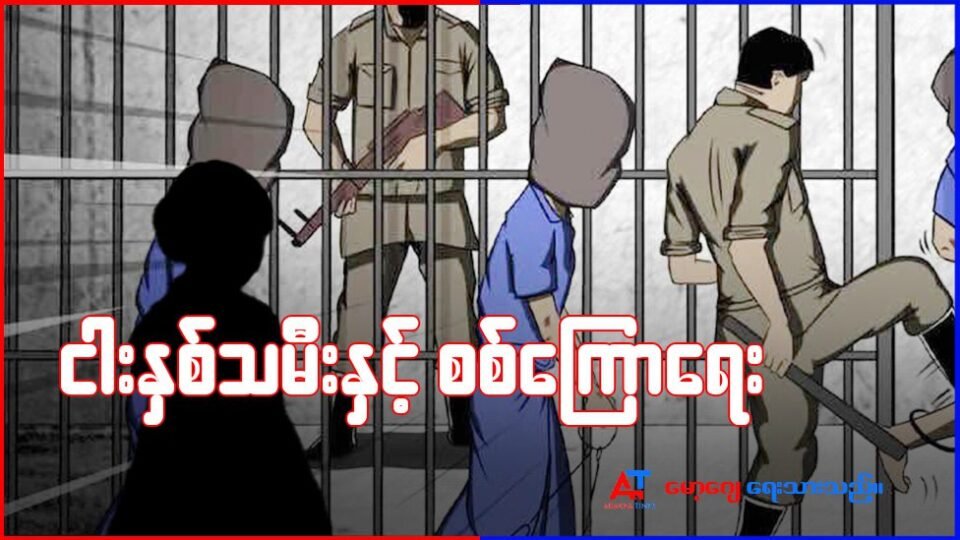
The family calls her the eldest daughter (A Kyi Ma). Nyein (a pseudonym), a five-year-old girl, watched in terror as soldiers treated her mother like a death-row prisoner—pulling a black hood over her head and fastening restraints on her hands and feet, fitting her with prison shackles and leg irons.
She was interrogated together with her mother for nearly nine days inside a cramped room at a military junta interrogation center. In the adjoining room, her aunt and her three-year-old cousin—who could not speak Burmese—were also being interrogated. In other rooms, her father and family friends were being tortured as well, something she realized from the agonized screams that broke out from time to time.
Although there is a stated rule that such acts of abuse should not be carried out in front of children, Nyein witnessed and heard every detail of these scenes.
December 19, 2023
That morning felt like an ordinary day for Nyein. Her father left home, saying he was going to work. She stayed behind, playing with her cousin, who had arrived from the countryside only a few days earlier. Her mother and aunt were nearby, doing household chores and keeping an eye on them. The cousin’s father and Nyein’s father are brothers.
While everyone was together at home, Nyein’s uncle received a phone call from her father, who was out at work. Using the excuse of going out to buy betel quid, the uncle stepped outside. Not long after he left, loud sounds of beating, shouting, and angry threats erupted from the narrow alley of their Insein riverbank neighborhood where they lived.
It did not take long. Armed soldiers climbed up into Nyein’s house, and right in front of the children who were playing, they aimed their guns at the mothers and began threatening them, shouting orders to hand over whatever they had.
“Resisting the military coup, and using mosquito net from military, huh” they yelled crudely. Around five or six soldiers behaved violently and abusively—some kept their guns trained on the women, while others overturned and ransacked everything in the house, rummaging through it aggressively.
Nyein, who was only five years old, and her three-year-old cousin clung to their mothers’ chests as the soldiers’ pointed guns at their mother and aunt and shouted threats at them. The children, too frightened to cry out loud, trembled uncontrollably and wept in silence.
When the soldiers failed to find what they were looking for, they aimed a gun at Nyein’s mother and said, “We’ve already arrested your husband. Hand over everything you’re hiding.” From the safety of her mother’s tight embrace, Nyein heard every word clearly.
From her mother’s embrace, Nyein could feel how her mother, shaking violently with fear as guns were pointed at her, struggled to speak as calmly as she could. She pleaded that if they had arrested her husband because she knew nothing, they should at least allow her to make a phone call.
No matter how much the soldiers kicked, cursed, and threatened them with guns, her mother shielded Nyein with her body and crouched over her, continuing to beg only for permission to speak with her husband. After some time, they finally heard a voice say, “We’ll let you make the call. After that, you’ll have to cooperate with us.” After those words, the abuse against her mother stopped. Because of that well-dressed senior soldier, Nyein’s family of four was finally allowed to sit properly on the floor.
A short while later, her father’s voice came through the phone on speaker, telling her mother where and which items to hand over. Her mother pushed Nyein toward her aunt and younger cousin, then went to fetch the things her father mentioned.
As soon as the items in her mother’s hands were taken, a senior soldier took photographs and ordered that her mother and aunt be handcuffed, hooded, and taken away.
Moments later, surrounded by the same soldiers who had been shouting and pointing guns—along with others waiting outside—Nyein, her mother, her aunt, and her cousin were forced to walk from their house, down the narrow alley, and onto a military vehicle. From the entire family, only the uncle who had stepped out earlier to buy betel quid managed to escape.
“The room was both cold and hot.”
From the afternoon they were arrested, Nyein and the others were driven for a long time before entering a place surrounded by long brick walls. When they reached an area with small rooms facing each other, they were ordered to get off the vehicle.
A door with a small opening was unlocked, and Nyein and her mother were placed in one room, while her aunt and younger cousin were put in another.
Each room had only a single door large enough for a person to enter. A single light bulb hung from the ceiling, and the walls were bare brick. Cameras were mounted all over the walls inside the room. As soon as they were taken in, they were made to sit on the floor and questioned.
They asked Nyein whether she had started school, what her parents did for a living, where they went, what was in their house, and who lived there—question after question without pause. Her mother, however, was questioned far more extensively.
Whenever her mother failed to answer their questions, the interrogators did not just shout insults and threats in a crude and abusive manner—they also lunged at her with their hands and feet. When Nyein clung to her mother and cried, begging them not to hit her, they cursed loudly and obscenely, saying they did not want to beat her in front of a child, and stormed out. Then another person would come in, interrogate and insult them, and leave—one after another.
When the uncle soldiers who questioned them more calmly came in, Nyein answered their questions. She said that she was attending kindergarten, that school was currently closed, and that a few days earlier she had gone to Shwedagon Pagoda with her father, mother, younger cousin, other family members, and her father’s friends, and that they had played at the playground. With those men, her mother also spoke calmly. They questioned both her mother and Nyein politely and did not hurl insults at them.
From time to time, they gave Nyein and the others food. The rice was not white; it was mixed with dark, lumpy bits and had a slightly unpleasant smell. The curry that came with it was something they could not even identify.
Her mother said to her gently, “My daughter, eat a little at least so you won’t be hungry. There are no snacks here, and you must not fall ill. Only if both you and I stay healthy will we be able to see your father.”
Nyein behaved obediently, just as her mother told her to. Whenever she needed to drink water or go to the toilet, her mother had to shout through the small opening in the door to ask. Later, when it was time to sleep, they brought in a set of bedding—a mattress, blanket, and pillow—that were very dirty and foul-smelling.
The room was extremely cold, so her mother spread the bedding on the floor, held Nyein close, talked to her, and sang songs to soothe her to sleep. Because of the cold, every time Nyein woke up during the night, she found her mother crying.
Woken by the noise, Nyein found that soldiers were once again questioning her mother inside the room. When her mother asked for permission for Nyein to relieve herself, they replied crudely,
“Just do it right there. You’re under arrest—stop causing trouble,” pointing at her with their hands and feet in a rude and threatening manner. Until the questioning was finished, nothing was allowed, so Nyein had to hold it in until they left. That day, the room felt unbearably hot. When they briefly opened the small door and went out, cool air would flow in, and that was a relief.
Along with the cool air, Nyein could sometimes hear her father’s voice from a room directly opposite theirs, mixed with voices that sounded like one of his uncles. At times, she also heard loud screams of pain. Sometimes her mother would press herself against the door to listen, and whenever she thought she heard a voice like her husbands’s, she would knock on the door and shout through the small opening that she needed to go to the toilet. Every time she did so, she was met only with curses and abuse.
Even when people from other rooms were being taken out, they were not allowed to leave. Fearing that she might need to urinate frequently, Nyein was given very little water to drink. To prevent repeated requests to use the toilet, they were forced to use a chamber pot inside the room. They were not allowed to go outside until the pot was completely full.
On the night of the second day, after being taken outside and then brought back, her mother looked unwell. That night, cries of pain were heard again and again. The next morning, a soldier who spoke politely came in and showed her mother some documents and a muted video. After watching it, her mother answered all the questions the soldier asked.
A short while later, the same soldier left and then returned. He said, “Why did you answer everything like that? By answering everything, you’ve only increased the number of charges that will be filed against you. Don’t answer the questions they ask you now. The CCTV has been turned off.” After saying this, he left again. Not long after, he came back with more documents, asked her mother a few additional questions, and made her sign several papers.
After the meal, the same polite soldier came again. He said that the aunt had been crying every day and asking to be kept together with Nyein and her mother, so they were moved to the aunt’s room. A soldier also brought clothes and snacks, saying they had been sent by the uncle—the father’s younger brother who had escaped when he went out to buy betel quid at the time of the arrest.
From that day on, Nyein, her mother, her aunt, and her little cousin all stayed together in the same room. Although the little cousin could not speak Burmese, she understood when Nyein spoke, so they were able to play together inside the room. Using the pencils that had been brought there, they drew a few pictures on the walls.
The mother and the aunt read aloud the writings already scratched on the walls and talked quietly among themselves about the people who had been held in those rooms before.
“I want to see the sunlight.”
“Please don’t let others suffer like me.”
Looking at the words “It hurts” written in blood and the rough, directionless scratch marks on the walls, they talked quietly among themselves. Every time the two little girls fell asleep and then woke up again, the two mothers could be seen talking and crying together. They constantly discussed what might happen “when we get outside.” Nyein did not understand what they meant by “when we get outside.” All she knew was that once they were outside, she would be able to see her father again.
December 27: Mother, then Father
Every morning, as soon as we woke up, we were allowed to step out of the room to wash our faces, rinse our mouths, and use the toilet, then return to the room. Although my uncle had sent us some clothes, we were not allowed to bathe. It had also been a long time since we were able to brush our teeth.
Not long after we returned to the room, a soldier opened the door and said, “Alright, get ready. Come out of the room. We’re transferring you to another detention area.” I thought that meant we were finally going outside—that I would get to see my father. Together with my mother and aunt, we quickly gathered our belongings. Holding my three-year-old cousin’s hand, I smiled and told her, “We’re going to see Papa and the others now,” as we stepped out of the room.
As soon as we stepped outside the room, the soldiers who were waiting there pulled a large black hood over my mother’s head. They shackled her hands and feet with iron restraints and chains. My aunt’s face went pale, and she tried to stop them, but no one responded to her at all. Sensing how frightened I was, my mother spoke to me and said, “My daughter, it’s okay. Nothing is going to happen—just like when we first came.”
When we were brought in earlier, even though my mother’s hands were tied, she was still able to hold me and walk with me. But now her feet were also shackled, and she couldn’t even raise her hands anymore. At that moment, a senior soldier ran over and said something, after which they removed the large black hood from my mother’s head and instead tied a black cloth tightly over her eyes.
When we were taken out of our room, many adults were also being led out from the rooms opposite us, all shackled in the same way as my mother, lining up as they came out. Among them was a man wearing the same clothes my father had been wearing when he left home. His body was covered in injuries, and he was walking slowly with the help of another man beside him.
When someone shouted at him to move faster, the sound of his reply made me certain that it was my father. Seeing him, I didn’t dare call out “Papa” the way I usually would.
“Mom, Dad and the uncles are coming behind us too,” I whispered softly, tugging at my mother’s clothes.
The four of us and the soldiers rode in one military vehicle, while my father and the other men were taken in another. After a long drive, we arrived at a police station and then a courthouse.
Without even being able to speak to my parents, the soldiers sent me, my aunt, and my little cousin back to the entrance of our neighborhood. After my aunt pleaded with them, a kind-hearted soldier returned 200,000 kyats out of the 1,000,000 kyats that had been confiscated from my mother. When my aunt also asked for the phone back, they told her to delete a photo showing three raised fingers from the phone before returning it.
When we returned home, the house was in complete disarray. After checking to make sure the soldiers had left, my aunt quickly packed some clothes into a bag, took my hand and my little cousin’s, and boarded the first vehicle she could find. We ended up in Khayan township. Not knowing where else to go, my aunt stayed at a small guesthouse there with the two of us and waited, trying to get in touch with my uncle.
After four or five days, my aunt managed to get in touch with my uncle. From where we were staying, we traveled for a long time by car and eventually arrived at the home of U U Oak Gyi in Tamwe, a friend of my father and uncle. We stayed at that house, and on court hearing days we went, one time to see my father, another time to see my mother together with the uncle.
Because I would have to be separated from my parents for a long time, my father and mother repeatedly reminded me through the detention room bars to listen to my uncle and aunt, to study hard, to eat well, and to stay healthy. When they were taken from the detention cells into the courtroom and had to walk along the way, if the police uncles and aunties escorting them were kind, I was sometimes allowed to hold my parents’ hands or hug them briefly.
One day, during one of our visits, I was able to see my father and mother for a little longer and we talked a lot. Both of them kept telling me how much they loved me and repeated the same words they always said. Because we would be separated for a long time, they carefully reminded me to take care of my health and to study hard, and then they hugged me tightly. After that day, when my father and mother were taken away in a large prison transport vehicle, my uncle no longer took me to the courthouse.
Nyein’s Prayer from the Heart
Nyein has no grandparents or extended relatives. The only relative she has is her father’s younger brother, her uncle. She stayed together with her uncle, aunt, and younger sister at U U Oak Gyi’s house. However, one day in December 2024, they were forced to move again and relocate to another place.
While moving from place to place with the two children, one day they were able to get in touch with Aunt’s parents. Grandfather and Grandmother discussed that, since Nyein’s parents had already been arrested, the soldiers would not harm Nyein, and because she was already of school starting age, it would be better for her to stay with them. They reassured everyone not to worry about sending monthly supplies to her father and mother, and urged Aunt’s family and the younger sister to flee to wherever they could find safety. With no other choice, Uncle and Aunt accepted the grandparents’ words, arranged to meet at a spot along the road, and had to leave Nyein behind.
Although Nyein had never met grandfather and grandmother even once before, they welcomed her warmly and cared for her as if she were their own grandchild, providing for her and sending her to school. Normally, for her age, Nyein should have been in Grade 2. However, because she had not been able to attend school regularly, she is now starting school again from Grade 1.
Now, it has almost been one full year since Nyein came to live with the grandparents. It has also been nearly two years since her father and mother were arrested and imprisoned. Nyein’s only wish is to be together with her whole family again—to go on a pilgrimage to Shwedagon Pagoda and to walk around Kandawgyi Park and the zoo as a family.
The military junta charged Nyein’s parents under multiple legal provisions, sentencing her father to more than thirty years in prison and her mother to more than twenty years. For Nyein, who does not understand court orders or prison terms, it is still beyond her comprehension that her father and mother will not be released for at least another twenty years when she herself will already be over thirty years old.
For Nyein, every night before going to sleep, she prays together with her grandfather and grandmother, wishing only that her father and mother are healthy and will be able to return to her as soon as possible.

1 comment