
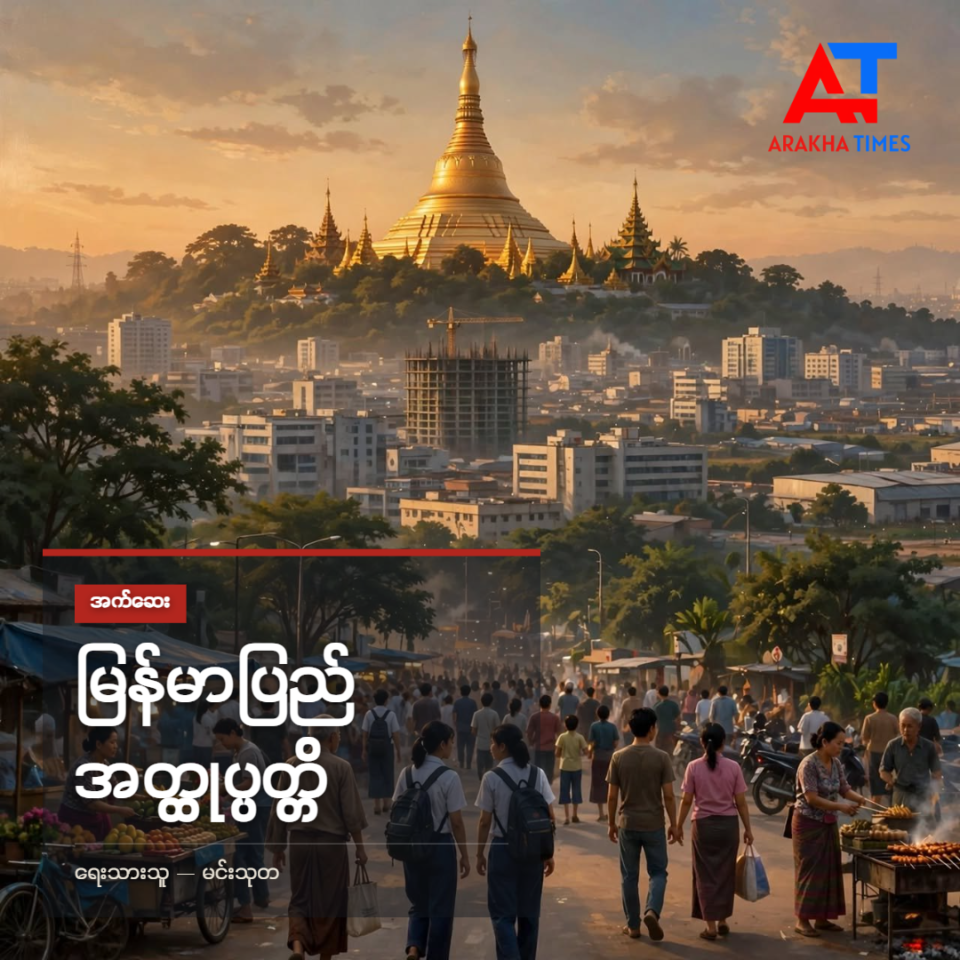
By Min Thuta
Yangon, Myanmar’s commercial capital, is a great city where people of many different backgrounds, from every region, state and township, live side by side. Buddhists, Christians, Hindus, Muslims and spirit worshippers all make their home here, so it would be fair to call it a city of interfaith harmony.
There are Buddhist monasteries, and there are Hindu temples, mosques and churches too. Yangon is a commercial capital, and it is also an industrial city.
Because it is a major industrial hub, you see every class of people in Yangon. Government officials, the wealthy, the educated and ordinary labourers are all there at once. They mirror the four ancient castes: the Khattiya, the Brahmana, the Vessa and the Sudda. Above all, it would not be wrong to call it a city of wage earners.
In Botahtaung, Pazundaung, Sule and Bahan you often see European backpackers. At night, foreign visitors gather on the platform of the Shwedagon Pagoda as its light glows and flickers. Sometimes students of foreign languages climb up to the platform to chat with foreigners and practise speaking for real. As a commercial and industrial capital, Yangon also has industrial townships such as Hlaingthaya, Mingaladon, Shwepyithar, South and North Dagon, and South and North Okkalapa. There, the main sight is factory workers in their various uniforms, squeezing onto ferry buses to reach the factories and workshops on time.
It is a pleasing sight to watch young men and women from different factories, each in their own uniform and each with a lunchbox, waiting for ferry buses at their stops. You could rightly call them a symbol of a modern, progressive industrial city. Young people from Arakan, Ayeyarwady, Kachin, Karen, Magway, Bago, Chin and other regions and states all meet in the industrial zones of Greater Yangon.
Each has a job and seems to live a comfortable life. Yet they all survive under labour laws and strict workplace rules. Arrive late and your pay is docked. Miss one day in a week and you may lose a whole week’s wages. More than two-thirds of the population are people who do not read, people who believe that “whichever government comes to power, you only eat if you work.” Among those who hold that philosophy are the day labourers, who must work each day to eat that day.
This is not just a wide view of Greater Yangon. You could fairly call it a wide view of the whole country. Then, on 1 February 2021, the military seized power. It arrested, one by one, members of the NLD government as it was preparing to form its second administration. The day of the coup became one of the darkest days in Myanmar’s history. Soon after, the protests in Yangon swelled into seas of people.
Every night at 8 p.m., every house in every town and ward banged pots and pans in protest against the dictatorship. Houses that stayed silent were accused of backing the dictator and had stones thrown at them. Even the staff and workers who had lived by “whichever government comes to power, you only eat if you work” marched out, chanting “Don’t go to the office, break free!” and “We must fight the final battle!” The protests and pot-banging did not last one day, or one month. Day after day and month after month, the pots kept ringing and the protests went on. Again and again, protesters clashed with police and soldiers on Yangon’s tarmac roads. People who used to ride ferry buses and squeeze onto city buses to get to work now marched in their own vehicles to protest.
After the coup, protesting by car became an everyday routine. The days when people did not go out to protest were, you might say, their days off. People who had stayed out of politics and simply worked to feed their families were now being battered by politics. People who once shed only sweat at work now shed blood in the protests. Those who gave their lives were honoured, as a final reward, with the title of martyr.
These were people who had once worked overtime. But life does not come with overtime, and wrapping a body in leaves cannot keep it alive. When I heard that a protester had been beaten to death in Hlaingthaya, I even felt sorry for Yama, the lord of death, who had done nothing to deserve such work. When the men who swear “the people are our mother, the people are our father” oppress those very people, the people themselves tore down the signs that read “Only when the Tatmadaw is strong will the nation be strong.”
When the daily protests were watched like a film being shot, and the nightly pot-banging was heard like a lullaby, the people were left with only one choice: to go to the jungle. Hands that had held chalk in classrooms, dressed in white and green, to nurture the nation’s young. Hands that had held ballpoint pens in factories, steering their families’ lives. Gentle, artistic hands that had painted murals to make walls beautiful. Hands that had gripped hoes as day labourers, holding to the belief that “whichever government comes to power, you only eat if you work.” All these hands, which once held such different tools to earn a living, now hold the same weapons, as brothers in the deep jungle.
Civil servants who signed pledges on their job applications to “stay out of party politics” have gone to the jungle and taken up arms. People who never read Leo Tolstoy’s “War and Peace,” translated by Mya Than Tint, are now staking their lives on the war. They long for the taste of peace the way a baby hungers for its mother’s milk. “It is not a seizure of power. It is a safeguarding of power,” they said.
Under the banner of “safeguarding,” more than five years have passed. In his own eyes, he now sits calmly on the royal throne as president. Just as the goddess Manimekhala rescued Prince Janaka, Myanmar’s story truly needs someone to bring dictatorship to an end.
“If a dictatorship wants to rule a country for 20 years, keep the people from reading. For 40 years, keep them illiterate. For 100 years, make them corrupt.” So goes a Chinese proverb. Are the people too busy holding weapons to read? Strength of arm matters for fighting, but strength of heart matters for building. So to win the government the people need, they must read while holding weapons, and be able to hold weapons while reading.
A few notes: I kept Buddhist and folk references such as the four castes, Yama and Manimekhala, because English readers can follow them. The “you only eat if you work” refrain is repeated on purpose, as in the original.
